
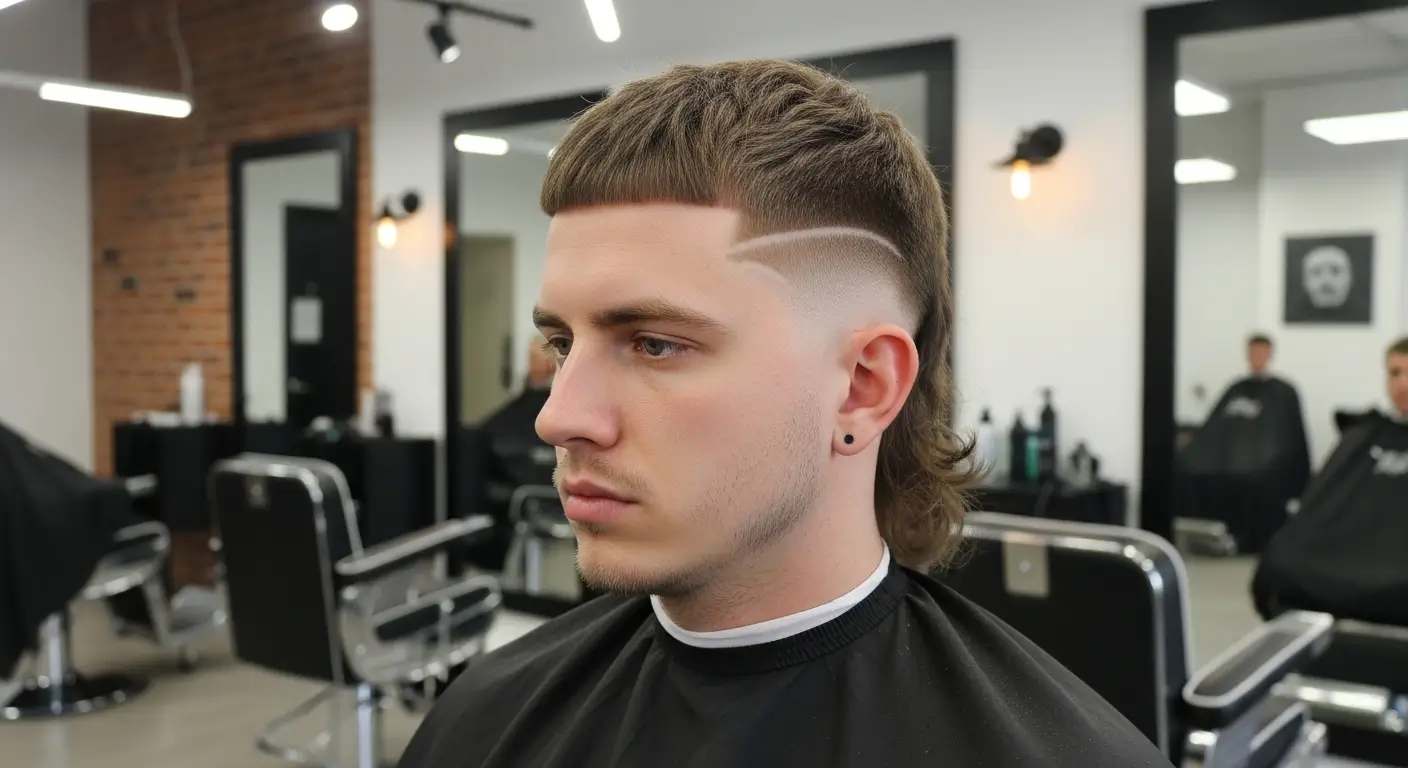
What exactly is a buzz mullet haircut, and how do you pull it off without looking like you lost a bet? Simply put, it combines a short, buzzed top and sides with longer hair left at the back — a hybrid of the classic mullet’s “business in front, party in back” and a military-style buzz cut. The result is a low-maintenance yet bold look that gained serious traction in the early 2020s, especially among Gen Z on TikTok and Instagram.
How to Get the Buzz Mullet Right: Practical Steps for Your Next Barber Visit
Before you sit in the chair, know what to ask for. The buzz mullet haircut relies on a precise contrast between the buzzed areas and the back length. Tell your barber you want a #1 or #2 guard on the top and sides — that leaves about 1/8 to 1/4 inch of hair. The back should be left anywhere from 2 to 6 inches, depending on how dramatic you want the contrast. A good barber will blend the transition gradually, so there’s no harsh line where the buzz ends and the longer hair begins.
If you’re doing it at home — and many did during the pandemic — invest in a quality clipper with adjustable guards. Start with a longer guard on top, then go shorter on the sides. Use a mirror to check the back, or ask a friend to help. The key is to keep the top uniform and the back shaped into a slight taper or point. You can also add a fade on the sides for a cleaner look, or shave in a design like a line or zigzag for extra edge.
Maintenance is straightforward but requires discipline. The buzzed parts need a touch-up every one to two weeks to stay crisp. The back, however, grows faster and can look shaggy if neglected. Plan a trim every three to four weeks to keep the mullet shape intact. Use a lightweight pomade or wax on the back to define the strands, but avoid heavy products that weigh down the short top.
One common mistake is letting the top grow out too long. The buzz mullet works best when the top is genuinely short — think stubble length. If the top gets past a quarter inch, it starts looking like a regular mullet, losing the military-inspired contrast. Stick to the buzz length, and you’ll keep the style’s signature edge.
What’s Confirmed vs. What’s Still Up for Debate About the Buzz Mullet
Celebrities like Miley Cyrus and Rihanna have worn variations, though neither has claimed to invent it. The style is undeniably tied to punk, grunge, and alternative fashion subcultures, and it challenges traditional gender norms — worn by both men and women without modification.
What remains unverified is the exact origin of the term “buzz mullet.” Some sources claim it emerged from military barracks where soldiers would shave their heads but leave a patch at the back as a rebellious gesture. Others argue it’s a modern invention, a product of the pandemic DIY haircut boom. There’s no definitive proof either way. Similarly, the claim that the style was “invented” by a specific barber or influencer is unsubstantiated — it seems to have evolved organically across multiple communities. A reference profile of the subject is maintained on Buzz Cut Mullet: The Hybrid Style That's Everywhere Right Now
Another disputed point is whether the buzz mullet is truly low maintenance. The buzzed parts are easy, yes, but the back requires regular shaping. Some barbers argue that maintaining the mullet shape is actually more work than a standard buzz cut. The truth likely depends on how strict you are about the silhouette. If you let the back grow wild, it becomes a different haircut entirely.
The Financial and Legal Angles: What the Buzz Mullet Costs and Why It Matters
From a financial perspective, the buzz mullet haircut can save you money on products — you won’t need shampoo, conditioner, or styling gels for the buzzed areas. But the regular trims add up. A professional barber visit for a buzz mullet typically costs between $20 and $50, depending on your location and the barber’s expertise. If you go every three weeks, that’s roughly $350 to $870 per year. Compare that to a standard buzz cut, which you can maintain at home with a $30 clipper for years.
There’s also a legal angle, though it’s niche. In some professional settings, unconventional hairstyles like the buzz mullet may conflict with dress codes. While workplace discrimination based on hairstyle is illegal in many jurisdictions under laws like the CROWN Act in the U.S., these protections often focus on race-based hair textures and styles, not on fashion choices. If you work in a conservative industry — finance, law, or corporate management — check your employee handbook before committing to the look. A few companies have explicitly banned “extreme hairstyles,” though enforcement is rare.
On the regulatory side, the buzz mullet has no direct legal implications. However, the trend’s association with counterculture has led to occasional scrutiny in schools or the military. In 2022, a U.S. high school made headlines for sending a student home over a mullet-style haircut, citing a dress code policy against “distracting” hairstyles. The incident sparked debate about personal expression versus institutional rules, but no lawsuit followed. For most people, the buzz mullet is simply a style choice with no legal baggage.
Inside the Buzz Mullet Trend: Key People, Events, and Cultural Impact
The buzz mullet haircut didn’t emerge from a vacuum. Its roots trace back to the punk and new wave movements of the 1970s and 80s, where musicians like David Bowie and Debbie Harry sported mullet-adjacent styles. But the specific buzz-mullet hybrid gained momentum in 2021, driven by TikTok creators like @hairbycharlie and @thebarberjosh, who posted tutorials that racked up millions of views. Instagram influencers followed suit, and by 2022, the style was a staple in alternative fashion circles.
Miley Cyrus wore a version during her 2021 “Plastic Hearts” era, pairing the buzz mullet with leather jackets and platform boots. Rihanna debuted a similar cut in 2022, though she kept the back longer and added a subtle undercut. These celebrity endorsements pushed the style into the mainstream, but the real engine was the pandemic. With barbershops closed, people grabbed clippers at home and experimented. The buzz mullet was one of the few DIY haircuts that looked intentional rather than accidental.
The style also became a gender-neutral statement. Unlike traditional mullets, which were often coded as masculine, the buzz mullet was embraced by women and non-binary individuals. It offered a way to keep short hair without conforming to the pixie cut or the buzz cut — both of which carry their own gendered baggage. The buzz mullet said, “I’m short on top, but I’m not playing by your rules.”
Today, the buzz mullet remains a niche but enduring choice. It hasn’t gone fully mainstream like the fade or the undercut, but it has a loyal following among those who want an edgy, low-maintenance look. Barbers report that requests for the style spike every few months, often after a viral TikTok or a celebrity sighting. Whether it becomes a classic or fades into a footnote of 2020s hair history depends on how many people are willing to commit to that back-of-the-neck length.
| Aspect | Buzz Mullet | Standard Buzz Cut |
|---|---|---|
| Top length | 1/8 to 1/4 inch | 1/8 to 1/4 inch |
| Back length | 2 to 6 inches | Same as top |
| Maintenance frequency | Every 1-2 weeks (buzz), every 3-4 weeks (back) | Every 1-2 weeks |
| Styling products needed | Light pomade or wax for back | None |
| Gender neutrality | High | High |
Frequently Asked Questions
How does a buzz mullet differ from a traditional mullet?
A traditional mullet keeps the top and sides longer — often several inches — while the back is even longer. The buzz mullet uses a buzzed top and sides (1/8 to 1/4 inch), creating a stark contrast with the longer back. This makes it more extreme and lower maintenance on top.
What is a buzz mullet haircut?
It’s a hybrid style that combines a short, buzzed top and sides with longer hair left at the back, typically 2 to 6 inches. The look blends the classic mullet’s silhouette with the practicality of a military buzz cut, often associated with punk and alternative fashion.
What is a good alternative to a buzz mullet if I want something less extreme?
Consider a modern mullet with a fade on the sides and a slightly longer top — about half an inch. This gives you the mullet shape without the full buzz. Another option is the undercut mullet, where the sides are shaved but the top is left longer for more versatility.
Is the buzz mullet appropriate for professional workplaces?
It depends on your industry. Creative fields like media, tech, or design are generally accepting. Conservative sectors like finance or law may view it as too unconventional. Check your company’s dress code; some explicitly ban “extreme” hairstyles, though enforcement varies.
Who popularized the buzz mullet in recent years?
No single person is credited, but TikTok and Instagram influencers drove its 2021 surge. Celebrities like Miley Cyrus and Rihanna wore variations, amplifying the trend. The pandemic also played a role, as people experimented with home haircuts and shared results online.