
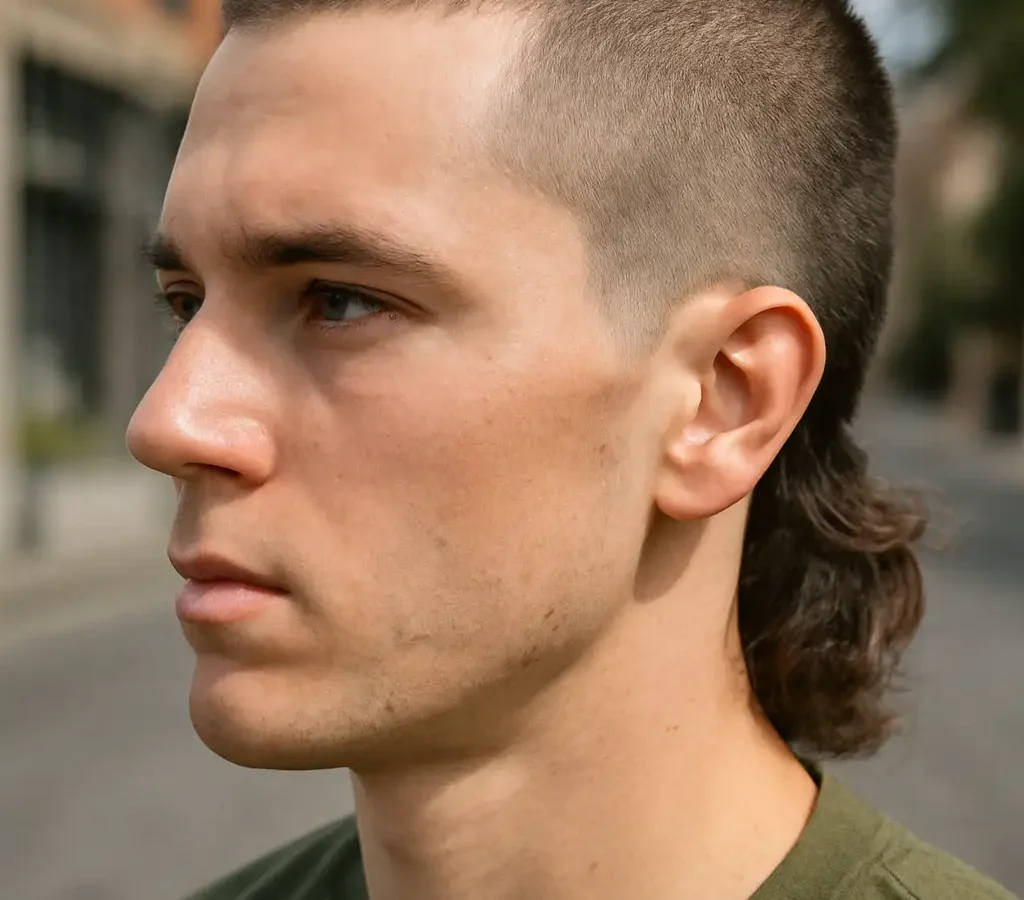
Walk into any barbershop on a Saturday afternoon and you might spot a young client asking for something short on top, longer in back. The barber reaches for clippers, then scissors. What emerges is a mullet buzz cut — a style that fuses the no-fuss utility of a buzz cut with the rebellious tail of a mullet. It is a look that says: I want to be practical, but I am not boring.
What Is Confirmed and What Remains Unverified About the Mullet Buzz Cut
The basic facts are solid. A mullet buzz cut uses clippers to buzz the sides and top very short, while leaving a longer section of hair at the back. This creates the classic mullet silhouette — short front and sides, long back — but with a buzzed texture rather than a grown-out top. The style is often called a “buzzcut mullet” or “skate mullet” in barbering circles. It emerged in the 1980s as a punk and alternative take on the traditional mullet, which itself dates back centuries. What is less certain is exactly who first popularized the buzz-cut version. Some sources point to skateboarders in the 1990s, who needed hair that stayed out of their eyes but still looked edgy. Others credit punk musicians who wanted a more aggressive, low-maintenance version of the mullet. The exact origin remains fuzzy, but the cultural lineage is clear: it is a child of punk and skate culture.
TikTok and Instagram feeds filled with videos of Gen Z users showing off their new mullet buzz cuts. Celebrities like Machine Gun Kelly and Travis Barker were spotted with variations of the cut, giving it mainstream visibility. However, whether the style truly became a widespread trend or just a niche online phenomenon is harder to verify. Barbers in major cities report an uptick in requests, but no national survey data exists. The cut is undeniably unisex — worn by both men and women — but again, no reliable statistics break down the gender split. What we can say is that the style challenges traditional gender norms in hairstyling, a fact that aligns with broader cultural shifts.
| Aspect | Confirmed | Unverified / Disputed |
|---|---|---|
| Origin decade | 1980s punk scene | Exact inventor or first wearer |
| 1990s popularity | Skateboarders and musicians | How widespread it was regionally |
| 2020s resurgence | TikTok and Gen Z interest | Whether it is a lasting trend or a fad |
| Celebrity endorsers | Machine Gun Kelly, Travis Barker | Whether they popularized it or just wore it |
| Gender neutrality | Worn by men and women | Proportional breakdown by gender |
Strengths and Weaknesses of the Mullet Buzz Cut: A Critical Look
The mullet buzz cut has real advantages. The buzzed top and sides require almost no daily styling — just a quick towel dry and you are done. For someone with a busy morning routine, that is a serious win. The longer back section, however, needs regular trimming to keep its shape. A good barber can maintain it every three to four weeks. The contrast between the short buzzed areas and the longer tail is what makes the cut visually striking. Straight or wavy hair shows this contrast best; very curly hair can blur the line, though some barbers argue that a defined fade on the sides can compensate.
One weakness is the grow-out phase. If you decide the mullet buzz cut is not for you, growing it out means enduring an awkward stage where the back is longer than the rest. This can take months. Another downside: the cut is not universally flattering. It works best on people with strong jawlines or angular faces, because the short sides emphasize the face shape. Rounder faces may find the look unflattering, though a skilled barber can adjust the fade to soften the effect. The weaker claim here is that the mullet buzz cut is a “one-size-fits-all” rebel style. It is not. It demands a certain attitude and willingness to stand out. In professional settings, it can still raise eyebrows, though that is changing as workplace dress codes relax.
Concrete examples help. Machine Gun Kelly’s version in 2021 featured a high fade on the sides with a long, dyed-pink tail. Travis Barker kept his more subtle — a low fade with a natural-colored back that blended into his existing punk aesthetic. Both examples show how the cut can be customized: with fades, designs shaved into the buzzed section, or dyed back sections. The most successful versions, in our view, are those that respect the wearer’s hair texture and face shape rather than blindly copying a celebrity photo.
Behind the Scenes: How a Mullet Buzz Cut Is Actually Cut and Maintained
Creating a mullet buzz cut is a two-tool process. The barber starts with clippers for the buzzed sections. A common approach is to use a #1 or #2 guard on the sides and top, depending on how short the client wants it. The back is left untouched initially. Once the buzzed areas are uniform, the barber switches to scissors to shape the longer back section. The key is to create a gradual transition — not a harsh line — between the buzzed sides and the longer tail. Some barbers use a fade technique on the sides to blend the two lengths more smoothly. The tail itself can be left blunt-cut or texturized with thinning shears for a softer look.
Maintenance is where the cut reveals its true nature. The buzzed top and sides need a clipper pass every two to three weeks to stay sharp. The back tail, however, grows slower and can go four to six weeks between trims. Many wearers learn to trim the back themselves with a mirror and scissors, though a professional touch is better for the shape. Washing is straightforward — any shampoo works — but the longer back may need conditioner to prevent tangling. Styling products are optional; a light pomade or wax can define the tail, but most wearers skip product entirely on the buzzed sections.
One detail novices often miss: the nape of the neck. The back tail should sit just above the nape or extend slightly below it, depending on the desired length. If the tail is too long, it can look like a traditional mullet rather than the buzz-cut hybrid. The best barbers will ask the client to tilt their head forward and back to check the tail’s position in motion. Another craft detail: the buzzed top should be slightly longer than the sides to avoid a flat, helmet-like appearance. A #2 guard on top and a #1 on the sides creates a subtle graduation that adds depth.
How the Mullet Buzz Cut Compares to Other Short-Long Hybrids
The mullet buzz cut sits in a family of hairstyles that mix short and long elements. The classic mullet, for example, keeps the top and sides longer than the buzz-cut version — often styled with volume or a fringe. The mullet buzz cut is essentially a mullet stripped of its top length, making it more utilitarian. Another close relative is the undercut, where the sides are buzzed but the top is left long and often swept back. The undercut offers more styling versatility on top, but requires daily product and blow-drying. The mullet buzz cut, by contrast, is almost zero-maintenance on top. Public records covering this story are gathered in 42 Buzz Cut Mullet Ideas – moderngentlemanmagazine.com
The “skate mullet” is practically synonymous with the mullet buzz cut, though some barbers use “skate mullet” to describe a slightly longer top with a disconnected undercut. The difference is subtle: the skate mullet often has a defined part or a slight fringe, while the mullet buzz cut keeps the top uniformly short. Both share the same cultural roots in skate and punk scenes. A more distant cousin is the mohawk, which shaves the sides completely and leaves a strip of longer hair down the center. The mohawk is more extreme and requires more upkeep for the central strip. The mullet buzz cut is a middle ground — rebellious but not as high-maintenance.
In terms of face shape compatibility, the mullet buzz cut favors oval and square faces, while the undercut suits rounder faces better because the longer top can add height. The classic mullet works on a wider range of face shapes because the top length can be adjusted. For hair texture, straight and wavy hair work best for the mullet buzz cut; very curly hair may need a longer top to avoid looking like a uniform buzz. The undercut handles curls better because the top can be left longer and shaped. Ultimately, the choice comes down to how much daily effort you want to invest. The mullet buzz cut wins on convenience; the undercut wins on styling flexibility.
Frequently Asked Questions
Who typically wears a mullet buzz cut?
The cut is unisex and popular among people in their teens to thirties, especially those in skate, punk, or alternative scenes. Celebrities like Machine Gun Kelly and Travis Barker have worn it, but it is also common among barbers, artists, and anyone who wants a low-maintenance edgy look.
Is a mullet buzz cut appropriate for professional workplaces?
It depends on the industry. Creative fields like design, music, or tech are generally accepting. More conservative workplaces like law or finance may still view it as unconventional. Some professionals opt for a subtler version with a lower fade and shorter tail to make it office-friendly.
How often do you need to trim a mullet buzz cut?
The buzzed sections need a clipper pass every two to three weeks to maintain the short length. The back tail can go four to six weeks between trims. Many people schedule a full barber visit every three weeks and trim the tail themselves in between.
How does a mullet buzz cut differ from a traditional mullet?
The traditional mullet keeps the top and sides longer — often styled with volume or a fringe — while the mullet buzz cut uses clippers to buzz those areas very short. The buzz-cut version is lower maintenance and has a more utilitarian, punk-inspired look.
What is the cultural impact of the mullet buzz cut?
It challenges traditional gender norms in hairstyling by being worn by all genders. It also represents a blend of punk rebellion and practical grooming. Its resurgence on TikTok in 2020–2021 shows how digital platforms can revive niche styles from past decades.