
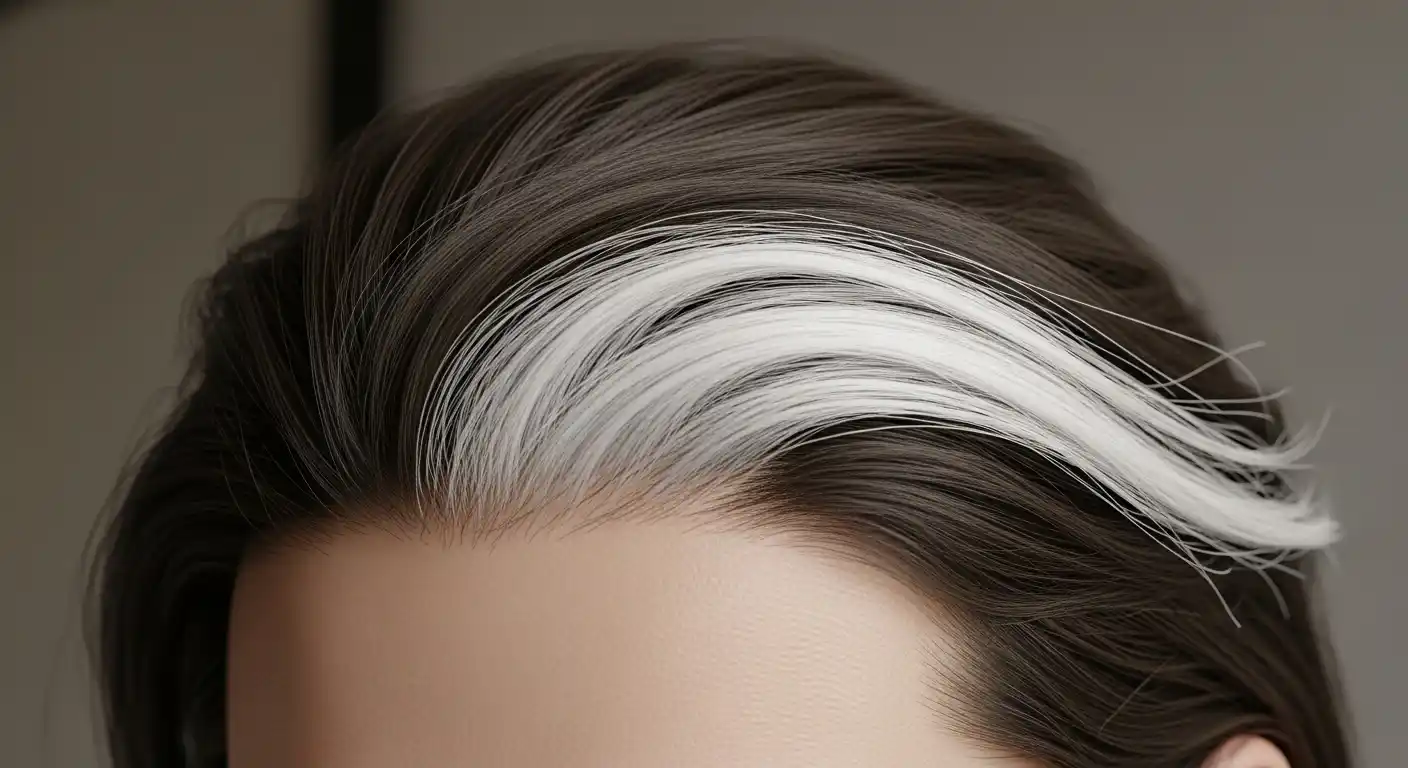
In a quiet dermatology clinic in London, a young woman asked about the stark white patch running through her dark hair. She had noticed it since childhood and wondered if stress or trauma had caused it. The answer, as doctors explained, was more likely a condition called poliosis — a localized lack of melanin in hair follicles. This white streak in hair, sometimes called a white forelock, can appear at birth or develop later in life.
What Science Says About White Streaks Today
Recent research has shed light on the biological mechanisms behind poliosis. In 2023, a study published in the Journal of the American Academy of Dermatology found a link between poliosis and alopecia areata, an autoimmune condition that causes patchy hair loss. The study suggested that in some cases, the immune system attacks melanocytes — the cells that produce pigment — leading to a white streak in hair. This connection helps explain why some people with alopecia areata also develop white patches. Public records covering this story are gathered in Why Do Some People Have A Natural Streak Of White In Their Hair?
Another area of investigation involves the role of genetics. Congenital poliosis, present at birth or in early childhood, is often associated with genetic syndromes. Waardenburg syndrome, for example, can cause a white forelock along with hearing loss and changes in skin pigmentation. Piebaldism, a rare genetic disorder, also features a white streak in hair from birth. These conditions arise from mutations in genes like KIT or MITF, which are crucial for melanocyte development.
Acquired white streaks, on the other hand, may stem from autoimmune disorders such as vitiligo. Vitiligo causes the immune system to destroy melanocytes in the skin and hair, resulting in depigmented patches. Model Winnie Harlow, who has vitiligo, has a visible white streak in her hair, which she has embraced as part of her signature look. Her public visibility has helped shift perceptions about this condition.
Stress and trauma are often cited as triggers for sudden hair whitening, but scientific evidence remains limited. The phenomenon known as Marie Antoinette syndrome — where hair turns white overnight — is extremely rare and likely involves a rapid shedding of pigmented hair rather than actual color change. A 2020 review in the International Journal of Trichology concluded that while stress can accelerate graying, it rarely causes a single white streak.
Cosmetic options remain the most common approach for those who wish to cover a white streak. Hair dyes, tinting sprays, and even temporary color waxes can blend the streak with surrounding hair. Some people choose to leave it natural, and social media trends have celebrated white streaks as a unique beauty feature. The hashtag #whitestreak has gained traction on platforms like Instagram and TikTok, where users share photos of their natural or styled white forelocks.
| Condition | Cause | Onset |
|---|---|---|
| Poliosis | Lack of melanin in hair follicles | Congenital or acquired |
| Vitiligo | Autoimmune destruction of melanocytes | Acquired |
| Waardenburg syndrome | Genetic mutation (e.g., PAX3) | Congenital |
| Piebaldism | Genetic mutation (KIT) | Congenital |
| Marie Antoinette syndrome | Rapid shedding of pigmented hair | Acquired (rare) |
How Different Regions and Demographics View White Streaks
Cultural attitudes toward a white streak in hair vary widely around the world. In many Western societies, gray or white hair has traditionally been associated with aging, and a single white streak might be seen as a quirky or even attractive feature. In recent years, fashion runways and beauty campaigns have featured models with natural white streaks, challenging conventional norms. The trend toward embracing natural hair colors has encouraged people to keep their streaks visible.
In some Asian cultures, a white streak can carry different meanings. In Japan, for instance, a white forelock might be associated with wisdom or spiritual insight, especially in older individuals. However, younger people with a congenital white streak may face curiosity or questions. In India, where dark hair is the norm, a white streak can sometimes be mistaken for premature graying, leading to social pressure to dye it. Bollywood actress Kajol has been open about her white streak, which she has chosen to keep, inspiring others to do the same.
Among African and African diaspora communities, a white streak in hair can be particularly striking against darker skin tones. Model Winnie Harlow’s vitiligo-related white streak has made her a prominent figure in the fashion industry, and she has used her platform to advocate for diversity. In South Africa, where she was born, her success has sparked conversations about beauty standards and representation.
Demographically, poliosis affects people of all ages and ethnicities equally, though certain genetic conditions are more common in specific populations. For example, Waardenburg syndrome occurs in about 1 in 40,000 people worldwide, with higher prevalence in some isolated communities. Piebaldism is even rarer, affecting an estimated 1 in 100,000 individuals. These numbers are based on medical literature, but exact statistics are difficult to verify due to underreporting.
Social media has played a significant role in normalizing white streaks. On platforms like TikTok, users share videos of their natural streaks, often using hashtags like #silverstreak or #whiteforelock. Some even dye their hair to create a faux white streak, mimicking the look. This trend reflects a broader shift toward celebrating unique physical traits rather than hiding them.
Key Moments in the History of White Streak Awareness
The history of the white streak in hair is intertwined with medical discoveries and cultural milestones. In the early 20th century, dermatologists began to distinguish poliosis from other forms of hair depigmentation. In 1910, French dermatologist Jean Darier described poliosis as a distinct condition, noting its association with certain skin disorders. This laid the groundwork for later research.
A significant milestone came in 1951 when scientists identified the genetic basis of piebaldism. Researchers observed that the condition ran in families and mapped it to a mutation on chromosome 4. This discovery helped explain why some people are born with a white streak in hair. In the 1990s, advances in molecular genetics pinpointed the KIT gene as a key player in melanocyte development.
In the 1970s, the term “Mallen streak” gained popularity, named after a character in a novel who had a white forelock. The term is sometimes used interchangeably with poliosis, though it is not a medical diagnosis. The character’s distinctive look helped popularize the idea of a white streak as a memorable trait.
More recently, in 2013, model Winnie Harlow rose to fame after appearing on America’s Next Top Model. Her vitiligo, which includes a white streak in her hair, made her a visible symbol of beauty diversity. Since then, she has walked for major fashion brands and spoken at the United Nations about inclusion. Her influence has encouraged others to embrace their own white streaks.
In 2023, the study linking poliosis to alopecia areata was published, providing new insights into the autoimmune connections. This research has implications for treatment, as it suggests that managing the underlying autoimmune condition might help prevent further depigmentation. However, no cure for poliosis itself exists, and treatment remains focused on cosmetic solutions or addressing associated conditions.
The Origins of White Streaks: From Genetics to Folklore
The origin of a white streak in hair can be traced back to ancient times. Historical records mention individuals with white forelocks, often attributing them to supernatural causes. In medieval Europe, a white streak was sometimes seen as a mark of witchcraft or divine favor. In some cultures, it was believed to be a sign of psychic ability or a connection to the spirit world.
On a scientific level, the condition is rooted in the biology of melanocytes. These cells, located in hair follicles, produce melanin — the pigment that gives hair its color. When melanocytes are absent or nonfunctional in a specific area, the hair grows white. In congenital cases, this absence is due to a genetic mutation that prevents melanocytes from migrating to the skin and hair during embryonic development. This process was first described in detail by embryologists in the 1960s.
Marie Antoinette, the Queen of France, was said to have turned white overnight after her capture during the French Revolution. While the story is likely exaggerated, it gave rise to the term “Marie Antoinette syndrome.” Modern scientists believe that sudden whitening is actually a rapid shedding of pigmented hair, leaving only white hairs behind — a phenomenon called alopecia areata diffusa.
In the 19th century, physicians began to systematically study hair pigmentation. In 1863, German pathologist Rudolf Virchow described a case of localized depigmentation in a patient with a white forelock. His work helped establish the link between hair color and melanin. By the early 1900s, dermatologists had classified poliosis as a distinct entity, separate from general graying.
Today, the origin of a white streak in hair is well understood in medical terms, but folklore persists. Some people still believe that a sudden white streak can be caused by a traumatic event or severe stress. While stress can trigger hair loss or graying, it rarely produces a single, localized white streak. The most common causes remain genetic or autoimmune.
Frequently Asked Questions
How many people have a natural white streak in their hair?
Exact numbers are difficult to determine because many cases go unreported. Congenital poliosis is rare, affecting an estimated 1 in 40,000 to 1 in 100,000 people, depending on the underlying condition. Acquired cases from vitiligo are more common, affecting about 1% of the global population.
Where is the white streak typically located on the head?
The white streak often appears at the front of the scalp, near the forehead, but it can occur anywhere. In conditions like Waardenburg syndrome, the forelock is usually centered above the forehead. In vitiligo, the streak may appear in patches anywhere on the scalp.
How does a white streak differ from premature graying?
Premature graying involves a gradual loss of pigment across many hairs, usually starting at the temples. A white streak is a localized patch of completely white hair, often present from birth or appearing suddenly. Graying is typically diffuse, while a streak is focal.
What is a white streak best known for in popular culture?
In popular culture, a white streak is often associated with distinctive characters, such as the villain in some stories or the hero with a unique mark. Real-life figures like model Winnie Harlow have made it a symbol of beauty and individuality, challenging traditional norms.
Who is most likely to develop a white streak in hair?
Anyone can develop a white streak, but it is most commonly seen in individuals with genetic conditions like Waardenburg syndrome or piebaldism, or autoimmune disorders like vitiligo. It can appear at any age, from birth to adulthood, and affects all ethnic groups equally.
How to Care for a White Streak in Hair
For those who choose to keep their white streak visible, proper hair care can help maintain its appearance. White hair is more porous and can be prone to yellowing from environmental factors like sun exposure, pollution, or product buildup. Using a purple shampoo once a week can help neutralize brassy tones and keep the streak bright. Some people also apply a leave-in conditioner with UV protection to prevent discoloration.
If the white streak is part of a larger condition like vitiligo, protecting the underlying skin from sunburn is important. The depigmented skin lacks melanin, making it more susceptible to UV damage. Applying a broad-spectrum sunscreen to the scalp area can reduce the risk of sunburn and skin cancer. A wide-brimmed hat or scarf also provides physical protection.
For those who want to cover the streak temporarily, root touch-up sprays or powders offer a quick fix. These products come in various shades to match natural hair color and wash out easily with shampoo. Semi-permanent hair dyes are another option, lasting several weeks. However, frequent dyeing can damage hair, so it is advisable to use gentle, ammonia-free formulas and deep-condition regularly.
Some people choose to highlight their white streak by styling it to stand out. Braiding or twisting the streak can draw attention to it, and some salons offer techniques like balayage to blend the streak with surrounding hair. Ultimately, the choice to cover or flaunt a white streak is personal, and there is no right or wrong approach.
Medical Treatments and Research Directions
While no cure exists for a white streak in hair, ongoing research explores potential treatments. For poliosis associated with alopecia areata, immunosuppressive therapies like corticosteroids or topical JAK inhibitors may help restore pigmentation in some cases. A 2022 clinical trial tested ruxolitinib, a JAK inhibitor, and found that some patients experienced regrowth of pigmented hair, though results varied.
For vitiligo-related white streaks, treatments include topical calcineurin inhibitors, phototherapy, and melanocyte transplantation. Narrowband UVB phototherapy can stimulate repigmentation in the skin and hair, but it requires multiple sessions over several months. Melanocyte transplantation, a surgical procedure, involves grafting healthy melanocytes onto depigmented areas, but it is not widely available and can be costly.
Gene therapy remains a distant possibility for congenital conditions like piebaldism. Researchers are investigating CRISPR-based techniques to correct mutations in the KIT gene, but these are still in preclinical stages. In 2021, a study in mice successfully restored melanocyte function using a viral vector, but human trials have not yet begun.
Another avenue of research focuses on stem cells. Hair follicle stem cells can differentiate into melanocytes, and scientists are exploring ways to activate these cells in depigmented areas. A 2023 paper in Nature Communications described a method to stimulate melanocyte stem cells using a small molecule, which led to hair pigmentation in mice. If translated to humans, this could offer a non-invasive treatment for white streaks.
Despite these advances, most treatments remain experimental or off-label. Patients interested in medical intervention should consult a dermatologist specializing in hair disorders. For the majority, cosmetic management is the most practical option.
Psychological and Social Impacts of a White Streak
Living with a visible white streak in hair can affect self-esteem and social interactions. Some individuals report feeling self-conscious, especially if the streak appears suddenly in adulthood. Others embrace it as a distinctive feature that sets them apart. A 2021 survey by the British Association of Dermatologists found that nearly 40% of respondents with visible skin or hair conditions felt that their appearance affected their confidence in social or professional settings.
Support groups and online communities have emerged to help people navigate these feelings. Forums on Reddit and Facebook allow individuals to share experiences and advice about living with a white streak. Many users describe a journey from initial concern to eventual acceptance, often inspired by seeing others with similar traits. The psychological impact can be mitigated by connecting with peers who understand the experience.
In the workplace, a white streak may attract attention or questions. Some people choose to explain the medical reason behind it, while others prefer to keep it private. There is no obligation to disclose personal health information, and many find that a simple, confident response suffices. Over time, the streak often becomes a normal part of one’s identity.